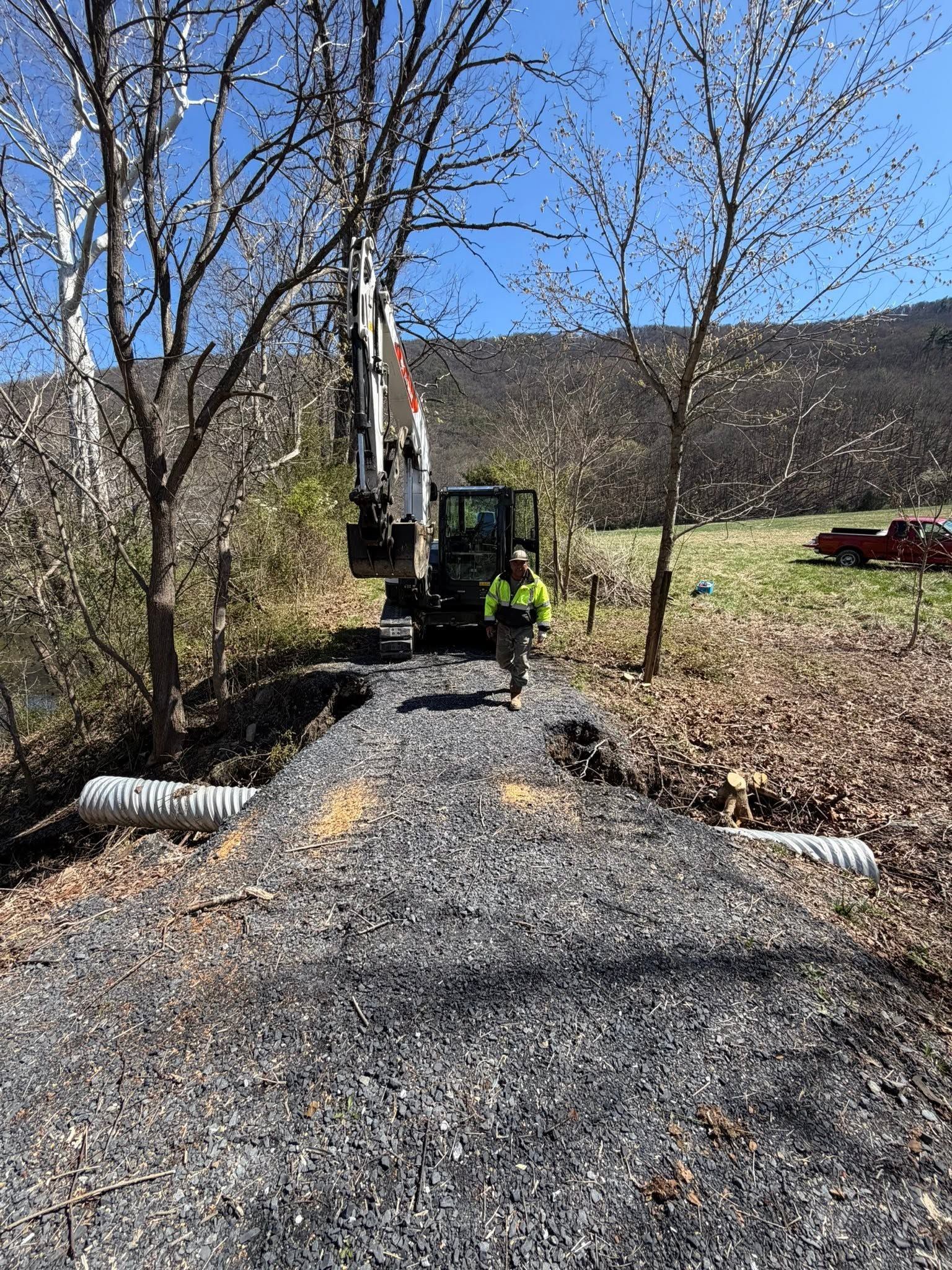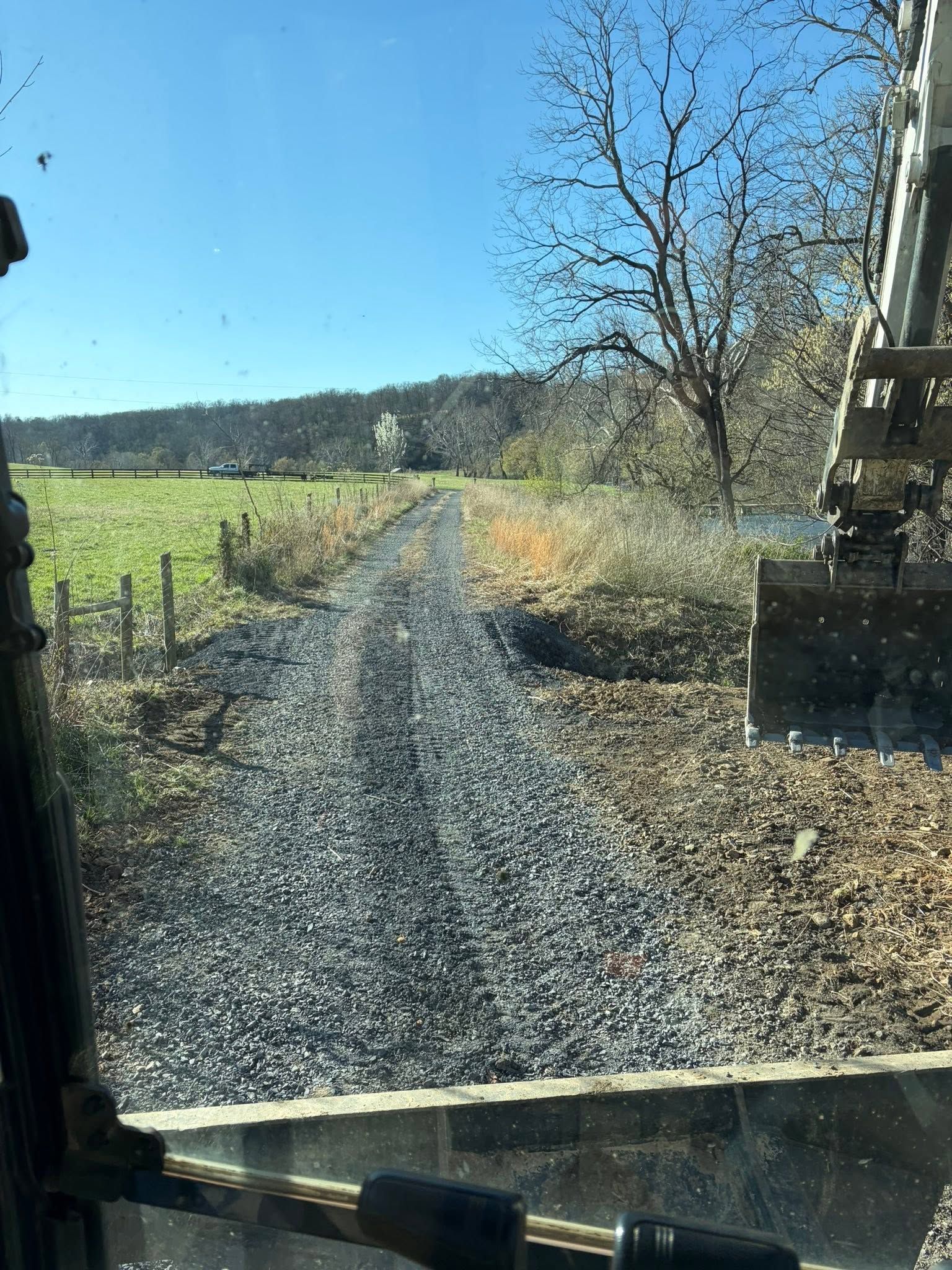

Rutted and Eroded Driveways Restored to Grade
Driveway repair in Edinburg for gravel surfaces showing washout, rutting, or uneven base failure
A gravel driveway that has developed deep ruts, soft spots, or visible washout channels is not simply a surface problem—the base layer beneath it has likely shifted, compacted unevenly, or lost its pitch. GT Excavation performs driveway repair across the Shenandoah Valley, addressing the structural conditions that cause recurring surface deterioration rather than applying a topdress that will wash out again after the next heavy rain. Rural properties throughout Shenandoah County frequently carry heavier vehicle loads than a standard residential driveway was built for, and that load history shows up in the base over time.
Repair work at GT Excavation is scoped and timed to match your budget and the actual condition of the driveway—not a fixed package that replaces material you don't need to replace. The owner manages access roads and driveway surfaces on his own farm operation, which gives him a practical understanding of how wear patterns develop on rural driveways, where base failure typically starts, and what repair approach will hold up under continued agricultural and vehicle traffic. That background directly informs how each repair job is scoped.
Arrange a free on-site estimate to assess the current condition of your driveway and determine what repair scope makes sense for your property.
How Driveway Repair Addresses Base and Surface Failure
Effective driveway repair begins with identifying whether the problem is limited to the surface layer or whether the base underneath has lost compaction, been undercut by water, or developed soft zones. Surface ruts that return within weeks of grading indicate a base issue; ruts that form slowly over months usually point to surface material loss from traffic or washout. The repair sequence differs depending on which condition is present, and addressing only the surface when the base has failed produces a temporary fix at best.
After repair work is complete, the driving surface should hold its grade across the full width without flexing under normal vehicle loads. Drainage channels along the edges should carry water away from the base rather than allowing it to pool and soften the center. On properties in New Market and similar areas where driveways serve both vehicles and equipment, a repaired surface that maintains its crown or cross-slope is the observable sign that base conditions were corrected, not just covered.
Not every repair requires regrading the full length of the driveway. Localized soft spots, failed culvert crossings, or edge erosion can often be addressed in sections, which is part of why scoping the repair against your actual conditions and budget matters before any material is moved. GT Excavation is Class A licensed and insured, and the repair approach is matched to what the driveway actually needs rather than defaulting to a full rebuild.
What Property Owners Ask About Driveway Repair Work
Gravel driveways on rural and agricultural properties in the Shenandoah Valley develop specific wear patterns based on traffic load, slope, and how the original base was constructed. These questions address the repair process itself.
How do you determine whether a driveway needs base repair or only surface regrading?
Probing soft areas, examining where ruts re-form after grading, and checking whether the driveway flexes under load reveals base failure; if the subbase is sound and only surface material has been displaced, regrading and topdressing is the appropriate scope.
What causes gravel to migrate off the driveway surface over time?
Gravel displacement typically comes from vehicle tires spinning or turning on loose material, edge erosion where the surface meets unpaved shoulders, and insufficient crown or pitch that allows water to move across the surface rather than off it.
When is a culvert replacement part of driveway repair?
When a driveway crosses a drainage channel and the culvert pipe has settled, collapsed, or become blocked, water backs up and saturates the base on both sides of the crossing, which is often the root cause of repeated soft spots in that section.
How does traffic load from farm equipment affect repair decisions on rural properties?
Heavy equipment with wide tires distributes load differently than passenger vehicles; a base depth adequate for car traffic may be insufficient for tractors or loaded trailers, which means repair on agricultural access driveways often involves adding base depth rather than just regrading the surface.
What indicates that a driveway repair was done correctly once the work is finished?
The surface should shed water toward the edges or drainage channels within the first rain after repair, and vehicle traffic should not produce immediate rutting or pushing of material—both confirm that pitch and compaction were addressed at the base level, not just the surface.
GT Excavation also performs driveway repair in Woodstock, Mount Jackson, Strasburg, New Market, and Middletown. To review your driveway's current condition and identify the repair scope that fits your property and timeline, contact GT Excavation directly at (540) 325-3806.